
Most salon owners set up their booking calendar once — and never think critically about it again. But the way you structure appointments has a direct impact on how much revenue each stylist generates per hour, how long clients wait, and how many appointments you can fit into a working day.
There are two primary appointment models used in professional salons and spas: consecutive booking and overlapping booking. Understanding the difference — and knowing which services work best under each model — is one of the fastest ways to increase your salon's revenue without adding a single new client.
What Is Consecutive Booking?
Consecutive booking is the simplest model: one appointment finishes, then the next one begins. The stylist completes the service fully before starting with the next client.
Example:
- 10:00 AM: Client A — Cut and Blow-Dry (60 minutes)
- 11:00 AM: Client B — Colour Service (90 minutes)
- 12:30 PM: Client C — Cut and Blow-Dry (60 minutes)
Advantages:
- Simple to manage and understand
- No risk of client overlap issues
- Works well for services that require constant attention throughout
Disadvantages:
- Leaves idle time when clients are processing (e.g., waiting for colour to develop)
- Lower revenue per stylist per hour
- Stylists may be standing idle while a colour client's hair processes
What Is Overlapping Booking?
Overlapping booking — also called staggered or parallel booking — allows a stylist to begin processing one client (such as a colour application) and then start a second appointment while the first client is in the waiting stage of the service.
Example:
- 10:00 AM: Client A — Full Colour Service (application: 30 min | processing: 45 min | rinse/blow-dry: 30 min)
- 10:30 AM: Client B — Cut and Blow-Dry (60 minutes) — begins while Client A's colour is processing
- 11:15 AM: Return to Client A for rinse and blow-dry
Advantages:
- Dramatically higher revenue per stylist per hour
- Reduces idle time during processing
- Can increase daily client capacity by 20% to 40%
Disadvantages:
- Requires careful scheduling — overlap conflicts must be calculated precisely
- Requires experienced stylists who can manage multiple clients simultaneously
- Can affect client experience if not managed well (clients may feel rushed)
When to Use Each Model
| Service Type | Best Booking Model | Reason |
|---|---|---|
| Haircut and blow-dry | Consecutive | Requires constant stylist attention throughout |
| Full colour application | Overlapping | Long processing time creates natural idle windows |
| Balayage / highlights | Overlapping | Processing time can accommodate a second client |
| Keratin treatment | Overlapping | Application and processing create idle windows |
| Manicure and pedicure | Overlapping | Each stage has natural waiting periods |
| Deep conditioning treatment | Overlapping | Processing time can fill with a haircut client |
| Express services (under 30 min) | Consecutive | Too short to overlap effectively |
| Medspa treatments | Consecutive | Usually require consistent monitoring |
Revenue Impact of Overlapping vs. Consecutive Booking
Let us quantify the difference. Assume a stylist works an 8-hour day and her average service generates 250 SAR:
Consecutive Booking (no overlap):
- Average service time: 60 minutes
- Services per day: 8
- Daily revenue per stylist: 2,000 SAR
Overlapping Booking (30 min overlap per colour service):
- Average services per day: 11 (3 additional colour overlaps)
- Daily revenue per stylist: 2,750 SAR
That is 750 SAR more per stylist per day — or 15,000 to 16,500 SAR more per month — without adding a single new client or extending working hours.
The Risks of Poorly Planned Overlapping
Overlapping only works when:
- Service times are accurately configured in your booking system
- The system automatically calculates buffer time between overlap stages
- The stylist has the experience to manage parallel clients without compromising quality
- Clients are informed (or it is simply seamless enough that they do not notice)
The failure mode of poorly planned overlapping is a client sitting in the chair, visibly waiting, while her stylist is occupied with someone else. This damages the client experience and creates the impression of disorganisation.
📊 Related: Key Salon Business Metrics: Staff Utilization and Revenue per Hour →
How Naeeman Handles Overlapping Bookings
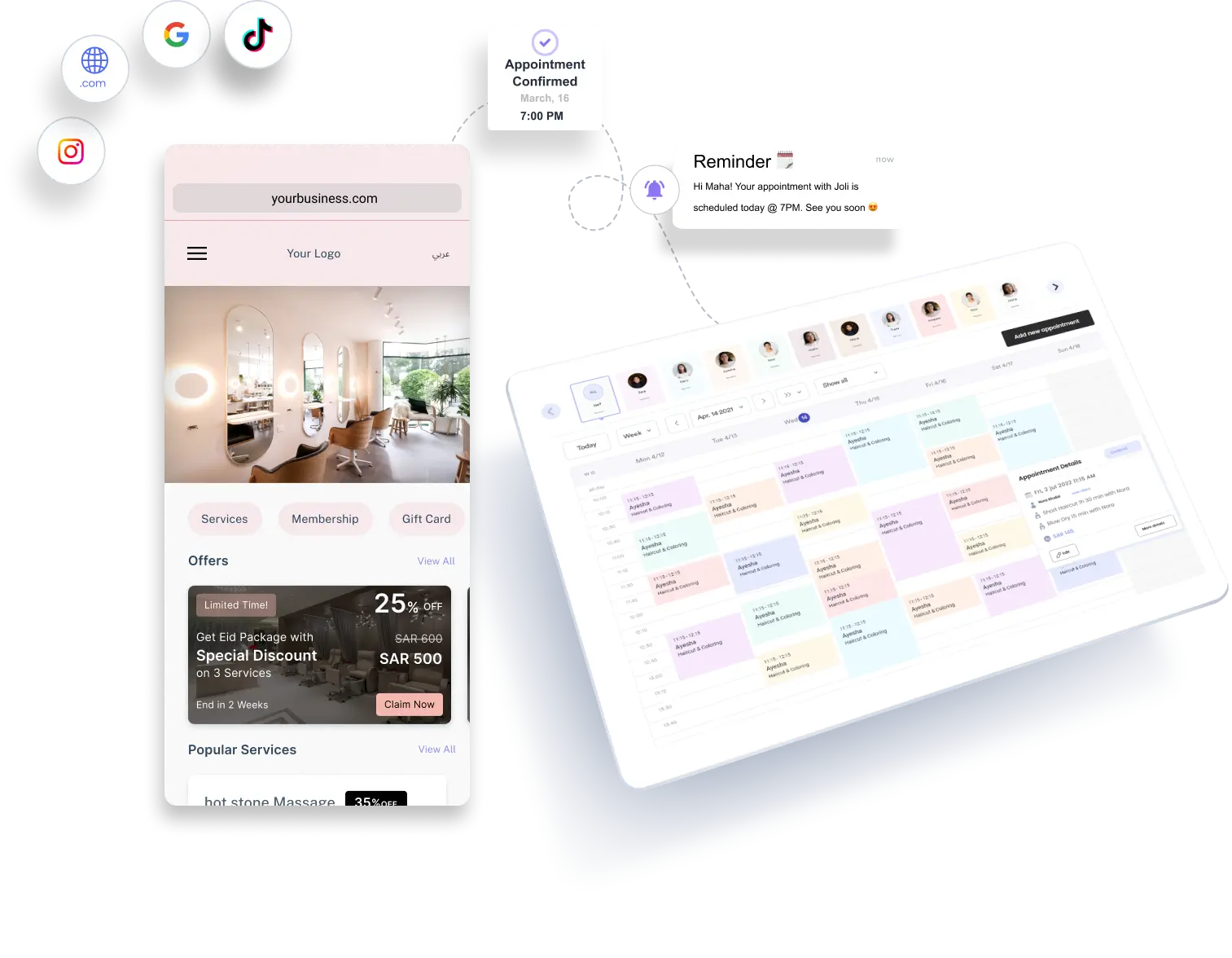
Naeeman allows you to configure service durations with separate stages: processing time, active time, and cleanup time. The booking system automatically calculates when a stylist is available for a second client during processing windows — eliminating manual coordination errors.
When a client books online, the system only shows availability based on the stylist's actual active time requirements, not the full service duration. This means overlapping is managed automatically, without requiring the receptionist or stylist to manually coordinate the schedule.
🚀 Book a Naeeman Demo — see how to configure overlapping service bookings and calculate the revenue impact for your salon.
Frequently Asked Questions (FAQ)
Is overlapping booking appropriate for all salons?
Overlapping works best for salons with experienced stylists who are comfortable managing multiple clients simultaneously, and where the service menu includes colour and processing services. For salons focused primarily on haircuts and express services, consecutive booking is often simpler and equally effective.
How do I tell clients that their stylist will be attending to another client during their colour processing?
Most clients expect this in a professional salon setting. Frame it naturally: "Your colour will be processing for about 45 minutes — we will check on you regularly and return for the rinse and finish." For new clients, a clear explanation builds trust rather than concern.
Can I mix consecutive and overlapping booking for different services?
Yes — and this is the recommended approach. Configure each service type with the appropriate booking model based on whether it includes natural processing stages. Your booking system should handle this automatically once configured correctly.
What happens if a colour service takes longer than expected?
This is a risk in overlapping booking. Mitigate it by building in buffer time between processing stages, and training stylists to communicate proactively with clients in the chair when timing changes.
CTA: Increasing revenue per stylist without adding new clients is one of the fastest profitability levers in a salon business. Book a Naeeman demo and configure overlapping booking for your colour services today.
