
The beauty and wellness industry in Saudi Arabia is experiencing rapid expansion, making it a highly attractive market for new entrepreneurs. However, opening a women’s salon or spa requires careful preparation.
To open successfully and avoid delays or fines, business owners must meet several municipal, legal, and digital compliance standards.
Navigating Salon Regulations in Saudi Arabia
Launching a beauty business in the Kingdom requires coordination between multiple government entities, including the Ministry of Commerce, the Ministry of Municipal and Rural Affairs (Baladiya), Civil Defense, and the Zakat, Tax and Customs Authority (ZATCA).
Ensuring your business is compliant from day one protects your investment and provides a professional foundation for your brand.
🔗 Related: E-Invoicing for Salons in Saudi Arabia: The Complete ZATCA Compliance Guide
Essential Municipal and Licensing Requirements
1. Commercial Registration (CR)
Your first legal step is securing a Commercial Registration from the Ministry of Commerce under the appropriate beauty and wellness activities.
2. Baladiya Municipal License
The local municipality regulates the physical layout of your salon. To secure a municipal license, your premises must meet specific spatial standards, including minimum area sizes, proper ventilation, designated waiting rooms, and separate areas for hair, nail, and skincare treatments.
3. Civil Defense Approval
Your physical location must pass inspections for fire safety, emergency exits, and electrical wiring safety before you can operate.
4. Health Certificates for Staff
All stylists, nail technicians, and therapists must have valid health certificates issued by approved medical centers to ensure hygiene standards are maintained.
Privacy and Spatial Standards for Women’s Salons
Due to cultural preferences and municipal guidelines in Saudi Arabia, women’s salons must adhere to specific privacy regulations:
- Privacy Entrances: The entrance layout must ensure that the interior of the salon is not visible from the street when the door is opened.
- Window Tinting: Street-facing windows must be tinted or covered to protect the privacy of the clients inside.
ZATCA and Digital Compliance Requirements
A critical modern operational requirement is digital tax compliance. In Saudi Arabia, paper billing is no longer legally acceptable for retail and service transactions.
Salons must implement a POS system that is fully ZATCA-compliant. The system must automatically generate simplified tax invoices containing a specific QR code for every checkout, allowing ZATCA to verify transaction details in real-time.
🔗 Related: Simplified Tax Invoices for Salons in Saudi Arabia: What You Must Include
Setting a Compliant Foundation with Naeeman
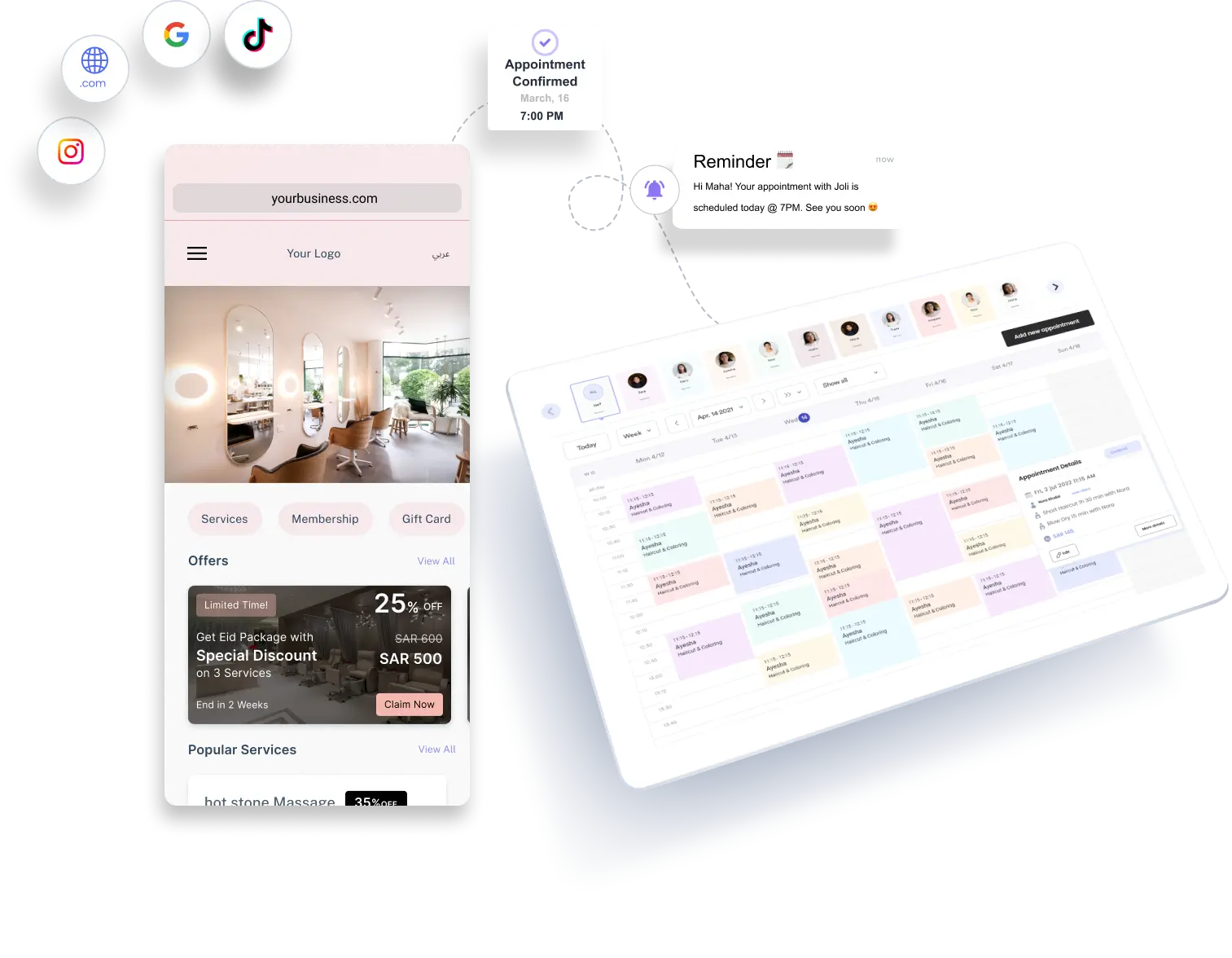
Naeeman simplifies the digital compliance process for new salons and spas in Saudi Arabia. As an all-in-one platform built specifically for the Saudi market, Naeeman provides a fully ZATCA-compliant point of sale that integrates directly with your booking calendar.
When a client checks out, the system calculates VAT, generates a ZATCA e-invoice with the required QR code, and updates your sales records automatically, keeping your business legally secure.
🔗 Related: How to Choose the Best Salon Software for Your Saudi Beauty Business
FAQ
What are the main licenses needed to open a salon in KSA?
You need a Commercial Registration (CR) from the Ministry of Commerce, a Baladiya license from your local municipality, and approval from the Civil Defense.
How does ZATCA e-invoicing affect my daily checkouts?
Every time a client pays for a service or retail product, you must issue a digital invoice containing a QR code. Your POS software must handle this process automatically to avoid administrative delays.
Are there specific privacy rules for women’s salons?
Yes. Municipal rules require street-facing windows to be completely private and the entrance design to prevent onlookers from seeing inside the salon.
Can I use a regular card machine for compliance?
A payment terminal only handles the cash transfer. You still need compliant salon software (like Naeeman) connected to your billing system to generate the required tax invoices.
Conclusion
Successfully launching a women’s salon in Saudi Arabia requires careful coordination of legal, spatial, and digital compliance standards. By selecting the right location, meeting municipal guidelines, and partnering with a localized platform like Naeeman, you set your business up for a compliant and profitable launch.
Book a Naeeman demo to see how our ZATCA-compliant platform can help you meet digital invoicing standards and manage your salon operations with confidence.
