
In Saudi Arabia, salon demand is not evenly distributed across the week or year. Thursday evenings, Fridays, the days before Eid Al-Fitr and Eid Al-Adha, National Day, and major social events create demand spikes that can easily overwhelm a salon that is not prepared.
The irony of peak periods is that they are your highest revenue opportunity and your highest risk of a poor client experience — at the same time. Overloaded stylists rush through appointments. Waiting rooms fill with frustrated clients. Quality drops. And the clients you most want to retain see your worst performance.
This guide covers a practical planning approach for Saudi salon owners to handle peak-demand periods profitably and without sacrificing service quality.
Identify Your Real Peak Windows
Before planning, you need data. Every salon has a different peak pattern:
Common high-demand patterns in Saudi salons:
- Thursday evenings and Fridays: Highest weekly demand across most Saudi cities.
- Pre-Eid (3–5 days before each Eid): The single most intense demand window of the year for many salons.
- National Day (around September 23): Styling demand rises significantly, especially in major cities.
- Wedding season: Varies by city and client base.
- Ramadan: Demand patterns shift — late evenings become busier.
If you are using a salon management system, pull your appointment history by day and time slot to see exactly when your peaks occur. If not, build this habit now.
📊 Related: Key Salon Business Metrics You Must Track →
The 5-Part Peak-Period Planning Framework
Part 1: Open Booking Early
For known peaks like Eid, open your booking calendar 3–4 weeks in advance. This allows your regular clients to secure their preferred slots — and allows you to see your expected demand before the rush hits.
- Enable online booking to allow 24/7 pre-Eid scheduling.
- Send a WhatsApp reminder to your client list 3 weeks before Eid: “Eid appointments are now open — book your slot before they fill up.”
- Consider requiring a deposit for peak-period bookings to reduce no-shows.
📅 Related: How to Reduce Salon No-Shows →
Part 2: Build a Peak-Period Staffing Plan
Your standard staffing schedule is designed for average demand — not peak demand. For peak periods, you need a separate staffing plan:
- Identify which stylists are available for extended hours during the peak window.
- Bring in freelance or contract stylists for the peak period if your capacity is insufficient.
- Redistribute tasks: assign a dedicated assistant to manage checkout, product refills, and station turnover so stylists spend 100% of their time on service.
- Add a dedicated reception resource for high-volume booking periods to manage walk-ins, phone calls, and last-minute changes.
Part 3: Optimize Your Service Menu for Peak Days
On your busiest days, offering a full menu of long, time-intensive services will create bottlenecks. Consider a peak-day service menu strategy:
- Prioritize high-value, time-efficient services (blow-dries, express treatments, nail services).
- Limit bookings for very long services (full color treatments, multiple-session packages) on the peak day itself — schedule those for the days immediately before the peak window.
- Offer express versions of popular services at a slight premium for peak-day slots.
Part 4: Set Realistic Client Expectations
Clients who arrive for a Eid appointment should know in advance what to expect:
- Send a pre-appointment message confirming the appointment time and asking the client to arrive on time (or 5 minutes early).
- If delays are likely on the busiest day, be honest: “We may be running 10–15 minutes behind schedule. We appreciate your patience and have a [service] ready for you while you wait.”
- Do not overpromise on completion time during peak periods.
💌 Related: WhatsApp Messages for Salons →
Part 5: Plan Your Recovery Period
After a peak period, your team is tired and your station quality may have slipped. Build a recovery plan:
- Schedule lighter booking loads for the 1–2 days after a major peak.
- Do a post-peak review: Which time slots were over-capacity? Which stylists were overloaded? Where did service quality slip?
- Use this data to refine your next peak-period plan.
What a Pre-Eid Salon Plan Looks Like
Here is a practical 4-week pre-Eid planning timeline for a mid-size salon:
| Week Before Eid | Action |
|---|---|
| 4 weeks before | Open peak booking. Send WhatsApp announcement to client list. |
| 3 weeks before | Review booking fill rate. Add extra stylist capacity if needed. |
| 2 weeks before | Send pre-appointment confirmation to all Eid bookings. Set deposit policy. |
| 1 week before | Finalize staffing schedule. Pre-order any additional product stock. |
| Peak days | Dedicated checkout staff. Express service options. Real-time schedule monitoring. |
| Post-Eid | Recovery schedule. Team feedback. Data review for next year. |
How Naeeman Supports Peak-Period Planning
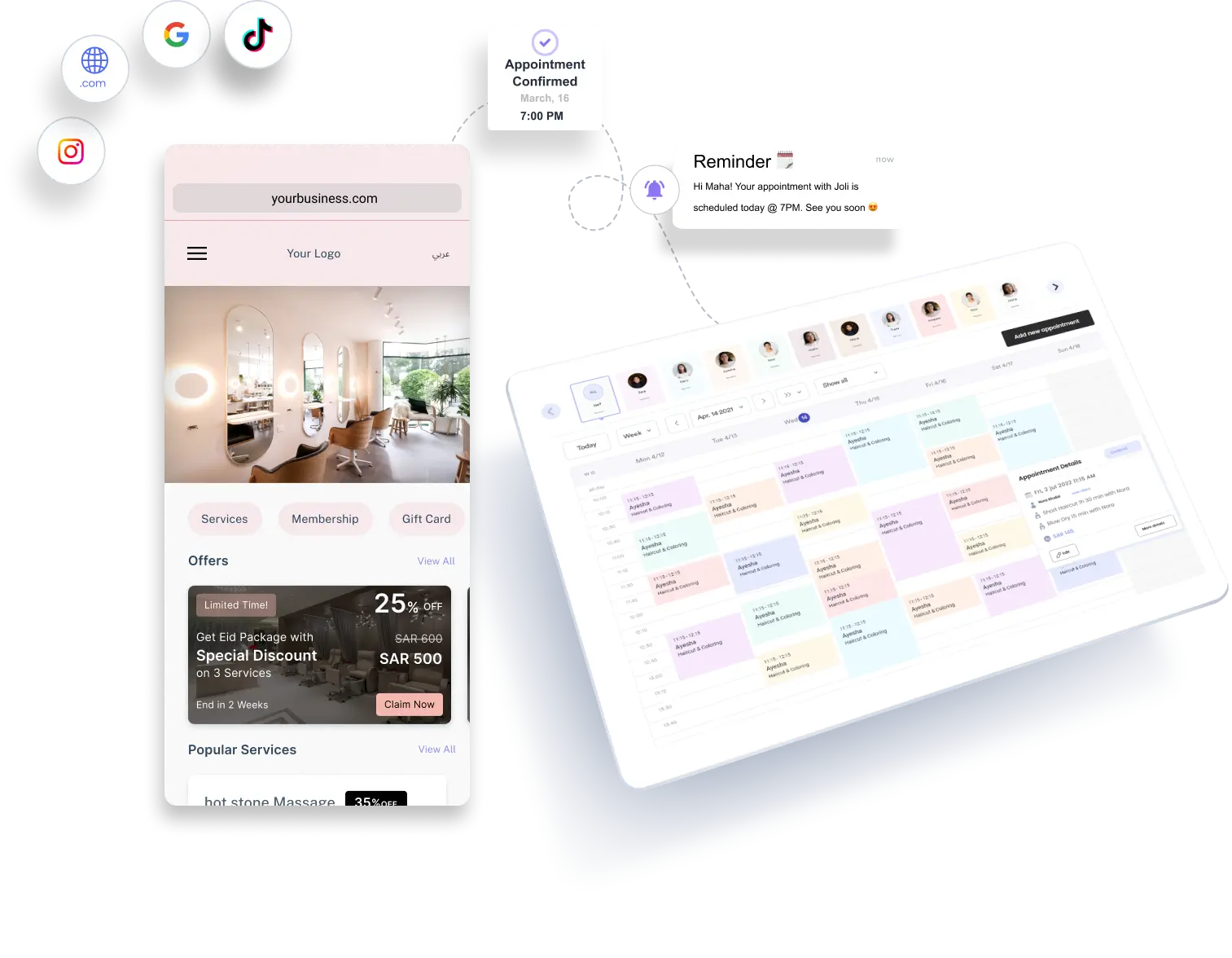
Naeeman gives you the scheduling, communication, and reporting tools to manage peak periods without chaos:
- Historical demand reports: Identify your real peak windows by day, time slot, and service type.
- Advance booking controls: Open specific date ranges for booking with deposit requirements.
- WhatsApp reminders: Send bulk pre-appointment messages to all peak-period bookings automatically.
- Live calendar monitoring: See real-time booking density and stylist load during peak days.
- Post-peak reporting: Analyze revenue, utilization, and service performance after each peak period.
🚀 Book a Naeeman Demo — discover how your salon can plan and execute peak demand periods more profitably and with less stress.
Frequently Asked Questions
How far in advance should I open Eid bookings?
Three to four weeks is generally effective for most Saudi salons. This gives regular clients enough time to secure their preferred slots while keeping demand visible before the peak hits.
Should I require deposits for Eid and peak-period appointments?
Yes. Peak-period appointments have the highest no-show and last-minute cancellation risk. Deposits — even partial ones — significantly reduce cancellations and protect your revenue. Clearly communicate your cancellation policy when the deposit is collected.
How do I handle clients who walk in during peak periods with no appointment?
Have a clear policy ready: your team is fully booked. Offer to add them to a waiting list or book their next appointment while they are present. Never disrupt a booked appointment to accommodate a walk-in.
What is the best way to manage stylist fatigue during peak periods?
Build mandatory short breaks into the schedule (even 10 minutes between back-to-back appointments), limit consecutive service hours, and bring in additional support staff so stylists focus only on service delivery.
How do I analyze whether my peak-period revenue was profitable?
Compare peak-period revenue against your cost for that period, including any temporary staff, extra products, and overhead. A Naeeman revenue report can break down earnings by day and service type to give you a clear picture.
Your busiest days should be your most profitable days — not your most chaotic. Book a Naeeman demo to see how our scheduling, WhatsApp reminders, and reporting tools help Saudi salons and spas handle peak demand with confidence.
