
Retail product sales represent one of the most underleveraged revenue opportunities in salons and spas. Industry benchmarks suggest that well-managed salon retail can contribute 15–30% of total revenue — yet most salons in Saudi Arabia generate only a small fraction of this potential, either because the team does not offer products consistently or because they approach it in a way that makes clients uncomfortable.
This guide covers how to build a retail system that feels helpful, not pushy — and how to manage your product inventory, staff performance, and client recommendations in a way that works for Saudi beauty businesses.
Why Salon Retail Often Fails
Before solving the problem, let us name it clearly:
Reason 1: The team does not know the products well enough.
A stylist who cannot explain why a keratin mask is right for a client’s hair type will not recommend it confidently. Product knowledge is the foundation of effective retail.
Reason 2: No one has set an expectation or a target.
If retail recommendations are optional and untracked, they will be inconsistent. If the topic never comes up in team meetings, it will not come up in the client chair.
Reason 3: The approach feels like a sales pitch.
Clients visit a salon for a service experience, not a shopping experience. Recommendations that feel scripted, rushed, or product-catalogue-like create resistance rather than interest.
Reason 4: The products are not visible or organized.
If retail products are stacked behind the counter or in a storage room, clients will not see them. Display matters.
Building a Natural Retail Recommendation System
Step 1: Product Knowledge as a Non-Negotiable
Every team member should be able to answer these questions for each retail product you carry:
- What is this product for?
- What hair or skin type does it work best for?
- When and how should it be used?
- What result does the client get from using it consistently?
Hold a monthly product education session. Bring in the brand rep if possible. Let team members try the products themselves.
Step 2: Consultation-Led Recommendations
The right moment for a product recommendation is during or immediately after the service — when the stylist has just diagnosed the client’s specific need.
Instead of: “Would you like to buy some hair treatment today?”
Try: “I noticed your hair needs more moisture from the roots. I used [Product Name] during your treatment today — it is really effective if you use it twice a week at home. We have it available here if you would like to continue the results.”
The difference: the second approach is grounded in the client’s specific situation and the service that just occurred. It is helpful, not transactional.
🔗 Related: How to Improve Salon Customer Experience →
Step 3: Display Your Products Strategically
- Place products at the reception desk and in the waiting area — not hidden away.
- Include simple signage explaining what each product does (not just the brand name).
- Group products by concern or result: “For dry hair,” “For color maintenance,” “For sensitive skin.”
- Use testers where appropriate.
Step 4: Set a Retail Target (Not a Quota)
A quota feels like pressure. A target feels like a goal.
Set a team retail target by service type. For example: a target of retail attachment rate of 20% on color services (meaning 1 in 5 color clients leaves with a product). Track it and discuss it in team meetings as a metric — not as a pressure point.
Managing Your Retail Inventory
Retail that generates revenue requires inventory discipline:
| Issue | Business Impact |
|---|---|
| Running out of a recommended product | Client cannot buy it, trust in recommendation erodes |
| Overstocking slow-moving products | Cash tied up, risk of expiry |
| Not tracking what sells | No data to guide ordering or training |
| Mixing retail and professional products | Operational confusion and potential compliance issues |
Basic inventory practices:
- Set a minimum stock level for each retail SKU.
- Review stock monthly — not just when you notice it is running low.
- Track retail sales by product line to identify what moves.
- Negotiate with suppliers for return or exchange rights on slow-moving products.
Upselling Services, Not Just Products
Retail is not only about products — it also includes upselling complementary services:
Service upsells that work in Saudi salons:
- Adding a scalp treatment to a blow-dry.
- Upgrading a basic manicure to a gel or nail art option.
- Adding a brow shaping or lash treatment to a facial appointment.
- Suggesting a follow-up toning or gloss treatment between color appointments.
The same principle applies: the recommendation should be grounded in the client’s specific situation and delivered as helpful advice, not as an upsell script.
📊 Related: Key Salon Business Metrics You Must Track →
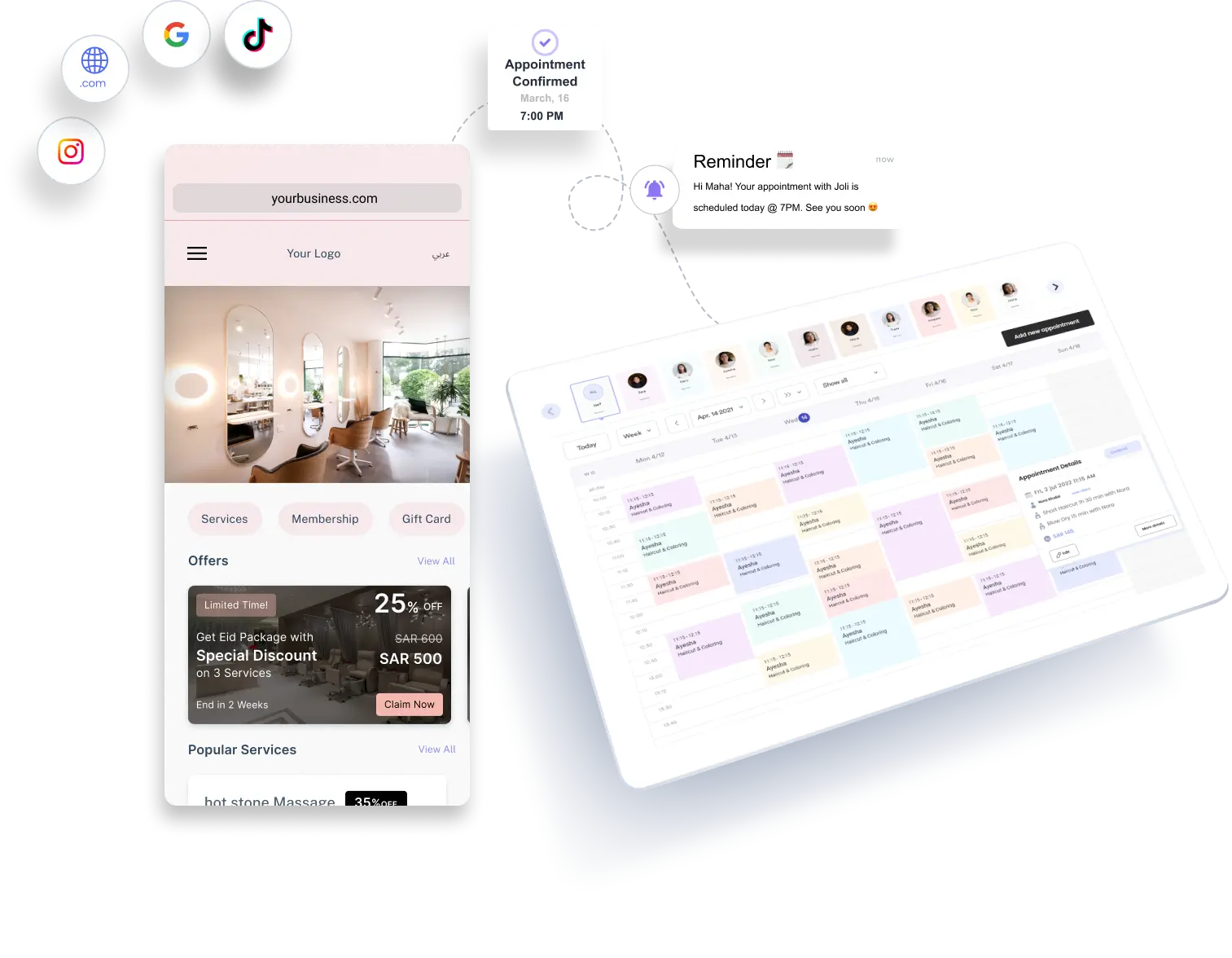
How Naeeman Supports Salon Retail Management
Naeeman helps you track retail performance alongside service revenue:
- Product sales reports: See which products sell, which do not, and which staff members are recommending most effectively.
- Inventory tracking: Monitor stock levels and get alerts before products run out.
- Revenue per visit: Track average ticket value to see the impact of retail and service upsells over time.
- Client purchase history: Know what a client has bought before — and what to recommend at their next visit.
🚀 Book a Naeeman Demo — discover how your salon can grow retail revenue through better tracking and client insights.
Frequently Asked Questions
What retail attachment rate should a salon aim for?
A well-functioning retail program typically achieves 15–25% attachment rate (percentage of service clients who also purchase a retail product). Start with a goal of 10–15% if retail is new or inconsistent in your salon.
Should I offer commission to stylists on retail sales?
Yes. A small commission (5–15% of retail product sale) creates tangible motivation without being aggressive. Make the commission visible and easy for stylists to track.
How do I handle clients who say “I can get it cheaper online”?
Acknowledge the point without being defensive: “Absolutely, and you can also order it online. The benefit of getting it here is we can show you exactly how to use it for your hair type, and we’ll be here next time if you have questions about results.” Convenience and expertise add value.
What products should a salon retail?
Focus on products that complement your most popular services. If color services are your top revenue driver, retail color maintenance products. If facials are popular, retail skin care. Align your retail range with your service specialties.
How do I train a team that is resistant to selling?
Reframe the conversation. Your team is not selling — they are giving professional recommendations that extend the client’s results at home. Present it as part of the service, not a separate commercial activity.
Retail is not about selling — it is about extending the client experience beyond the salon. Book a Naeeman demo to see how product tracking and client insights can help your salon grow revenue without pressure tactics.
